Bradley Benner
Founder at Semantic Links & TreeCareHQ | Local SEO Expert for Agencies & Tree Care Pros | White-Label Services & Industry Growth Strategies
social
About Bradley
I am Bradley Benner, a Local SEO specialist and the founder of Semantic Links and TreeCareHQ. I help local businesses and the agencies that serve them win more customers by improving visibility in local search and building authority the right way.
Over the past decade plus, I have worked across local lead generation, branding, paid ads, content marketing, reputation building, and Google Business Profile optimization. I started in marketing and promotions and later built and operated a lead generation and local SEO agency focused on home service contractors. That hands on experience taught me what matters in the real world, predictable lead flow, profitable campaigns, and systems that scale.
Today, my main focus is semantic and relevance driven link building for local SEO. I built Semantic Links to provide fully managed, white label link building using exclusive sources that are topically and or geographically relevant, with transparent reporting and a clear plan tied to outcomes.
I am also passionate about helping tree care professionals grow. Through TreeCareHQ, I bring together local search strategy, lead management systems, and growth consulting tailored to arborists and tree service companies.
I love simplifying complex SEO into practical steps, backed by data, so business owners and agencies can make smarter decisions, protect margins, and get better results over the long term.
Message Me
How can I help you?
Subscribe for Updates
Subscribe to my newsletter to get updates on my latest content.
Meet
Coffee Chat with Bradley
Hey there, thanks for stopping by. If you are into local SEO, agency growth, or home service marketing, I would love to connect.
I offer a free, informal 30 minute virtual coffee chat to swap ideas and talk shop with zero sales pressure.
We can chat about Google Business Profile trends, topical and geographic relevance, link building that actually moves the needle, reporting and fulfillment workflows, or marketing for tree care and other local service businesses.
If that sounds useful, send a message and we will pick a time.
1:1 Local SEO Link Strategy Call
Work 1 on 1 with Bradley Benner, founder of Semantic Links and TreeCareHQ, with 10 plus years in local SEO, lead generation, and agency operations. We will review one local business or client campaign, diagnose why rankings are stuck, and build a relevance first link and content roadmap.
Expect a clear action plan covering GBP priorities, competitive gaps, link strategy, timelines, and what to stop wasting money on.
Blog
Stop Lying to Google on Behalf of Your Clients: The Verifiable Truth Layer in Local SEO

I review a lot of on-page work. As a white-label service provider, auditing the campaigns that agencies submit to Semantic Links is part of my daily reality. And I'm going to be straight with you: most of what I see is bad. Not bad in the sense of outdated tactics or missed opportunities. Bad in the sense that the claims being made on behalf of local business clients are easily verifiable as inaccurate. That is a different kind of problem, and it is becoming a much more serious one.
The SEOs making these mistakes are not lazy. Most of them are working hard for their clients. But they are still operating with an outdated mental model of what on-page optimization is supposed to do. They are still writing content and structuring pages as if the goal is to convince an algorithm, to present a version of reality that earns rankings regardless of whether it reflects the truth. That approach is not just ineffective anymore. It is actively working against the sites they are trying to rank.
Language models can now fact-check on-page claims in real time. That changes everything about how we should be doing this work.
The Algorithm Has Learned to Call Your Bluff
Google's natural language processing has gotten remarkably good at understanding what a page is actually claiming, and cross-referencing those claims against what it already knows about the world. When a page says one thing and verifiable external data says another, the model notices. And when the model notices, the page loses credibility, not just for the specific claim, but as a source of information overall.
I see this play out most clearly in local SEO with geographic targeting. The pattern is almost universal. A business is physically located in one city, and the SEO optimizes the homepage for that city. But then, elsewhere on the site, the content starts referencing a completely different city, usually a larger adjacent metro, because that is where the client wants to rank. The logic makes sense from a business goals perspective. The execution is a disaster from a verification standpoint.
Here is the specific problem. The homepage is the foundational identity document for a website. It signals to both human visitors and models: this is who we are, this is what we do, and this is where we do it. When that homepage is optimized for one location but other pages on the site claim service in a different location, including one that the Google Business Profile clearly contradicts, you have created an easily verifiable inconsistency. The model does not have to work hard to detect it. The GBP alone exposes it.
And yet, this is one of the most common on-page mistakes I see, across agencies of every size and experience level.
Location Is Not the Same Thing as Area
Part of the reason this keeps happening is that most SEOs are not making a clean distinction between a location and an area. These are not interchangeable terms, and treating them as if they are is what leads to the geographic contradiction problems I described above.
A location is specific. A city, a town, a census-designated place, an unincorporated community, a township. It is a discrete, defined place with a name that can be looked up, verified, and matched to coordinates. When you optimize a page for a location, you are making a claim that the business is connected to that specific place.
An area is broader. It is a collection of locations, a region that contains multiple cities or towns within it. A metro area, a county, a regional designation. When you optimize for an area, you are saying the business operates across this broader geographic region, which can encompass multiple specific locations.
Most service area businesses, whether they are tree service contractors, plumbers, HVAC companies, or mobile repair services, actually want to rank across an area. But what their SEOs do instead is optimize for specific locations they do not have a verifiable claim to. They pick the biggest nearby city and try to make the site look like it belongs there. Then the GBP, which shows the actual business address, contradicts everything the site is trying to assert.
The fix is not complicated. Optimize for the area, and let the area contain the specific locations. Do not make location-level claims you cannot substantiate. If a service area business is based in a suburb outside a major metro, it can absolutely reference the broader metro region as part of its service area. What it cannot do without consequence is pretend to be headquartered in that city when the GBP says otherwise.
Building a Verifiable Geographic Framework
So how do you actually determine what geographic hierarchy to optimize within? I use a simple method that is grounded in the same publicly available data sources that language models are trained on.
Start with the city or town where the Google Business Profile is physically located. That is your anchor. Then go to Wikipedia and search for that city or town.
Within the first paragraph of almost any Wikipedia page for a city or town, you will find a reference to the county that city or town is contained within. That county is your next level up in the hierarchy. Click through to the county's Wikipedia page, and within the first paragraph or two, you will typically find the metropolitan area or regional entity that the county belongs to. That metro region is your broadest viable targeting layer for most local SEO campaigns.
So the hierarchy looks like this:
1. City or town, where the GBP is physically located
2. County, which contains that city or town
3. Metropolitan area or region, which contains that county
This framework matters because it mirrors how models understand geographic relationships. Wikipedia is one of the most heavily weighted sources in language model training data. When you optimize within a geographic hierarchy that is clearly established in Wikipedia, you are aligning your on-page claims with a structure the model already understands and trusts. When you make up your own geographic logic to serve your client's ranking ambitions, you are working against that structure.
Most local SEO campaigns do not need to go broader than the metropolitan area, and even a full metro can be an overly ambitious target for many businesses. But referencing the broader area, even if the business only operates in part of it, is a legitimate and verifiable claim. Claiming you are located in a city where your GBP shows you are not is not.
Verifiability Is the Strategy Now
The old playbook was built around convincing algorithms. Write the right words in the right places, get enough links pointing at the page, and the rankings would follow regardless of whether the underlying claims were accurate. That playbook is finished.
The new reality is that the models reviewing your clients' sites are increasingly capable of asking: is this true? They are not just pattern-matching keywords anymore. They are evaluating claims against a body of knowledge, and they are good enough at it now that unverifiable claims are a genuine liability. Publishing them is not a neutral act. It actively signals to the model that the source is unreliable.
My job now, and the job of any serious local SEO professional, is to figure out how models understand the relationships between entities, between locations, between areas, between businesses and the geographies they serve, and then optimize within that framework. Not against it. Within it.
If you can't beat them, work within the framework they've established. Make every claim on your client's site something that a model, or a curious human visitor, can verify and validate. That means aligning geographic targeting with the actual GBP location. It means distinguishing between the area your client serves and the specific locations they are physically tied to. It means building a site that tells a consistent, verifiable story from the homepage all the way through to the service pages.
That is not a limitation. That is the actual job.
If you want to know whether your current client sites are making verifiable claims or creating liabilities, that is exactly what my on-page audit service through Semantic Links is built to assess. I go through the site, identify the claims being made, cross-reference them against what is verifiable, and give you a concrete set of recommendations to bring everything into alignment. It is the kind of review that tends to surface problems agencies did not know they had, and in most cases, fixing them moves the needle faster than any link-building campaign would.
Before You Build an AI-Powered Agency, You Need to Get Your House in Order

I see it constantly with my coaching students. Someone discovers agentic workflows, gets excited, and immediately tries to point an AI model at their business. Within a week, they're frustrated. The AI is producing inconsistent outputs, missing client context, and generally making a mess of things. They blame the tool. But the tool is not the problem.
The problem is that they handed a powerful system a disorganized operation and expected it to sort everything out. It does not work that way. AI does not fix chaos. It amplifies whatever it is given. If your foundation is shaky, adding AI to the mix compounds your problems instead of solving them.
I have been building agentic workflows into my own agency operations and teaching my coaching students to do the same. What I have learned through that process is that there are three foundational layers you need to have in place before you even think about automating a single task. Get these right first, and AI becomes genuinely transformative. Skip them, and you are going to waste a lot of time and money going in circles.
Layer One: Build a File and Folder Structure That Both Humans and AI Can Navigate
This sounds almost too basic to mention, but it is the thing I see most agencies get wrong. Your folder and file structure needs to be logical, consistent, and navigable, not just for your team, but for the AI agents that will eventually be working through it.

I use Cursor as my harness for building and running agentic workflows. Across my agency, I am managing over 200 monthly campaigns through that system. The only reason it works at any kind of scale is because the underlying folder architecture is clean and consistent. The AI can find what it needs without getting lost, and so can any human on my team.
The framework I have been implementing is called the Interpretable Context Methodology, developed by Jake Van Clief (Clief Notes Skool Community). The core idea is that you have to think of your agency as a system first, and then build your file structure to reflect that system. Every folder, every file, every naming convention should be purposeful. Nothing arbitrary.

When you get this right, something important happens. The AI agent can move through your client data efficiently because the structure is predictable. There are no dead ends, no orphaned files, no folders that made sense six months ago but are a mystery now. It becomes a shared language between your human personnel and your AI agents, and that shared language is what makes collaboration between the two actually functional.
Layer Two: Build a Second Brain That Unifies Your Operational Knowledge and Client Data
The second foundational layer is the second brain system, and it serves two distinct but equally important purposes.
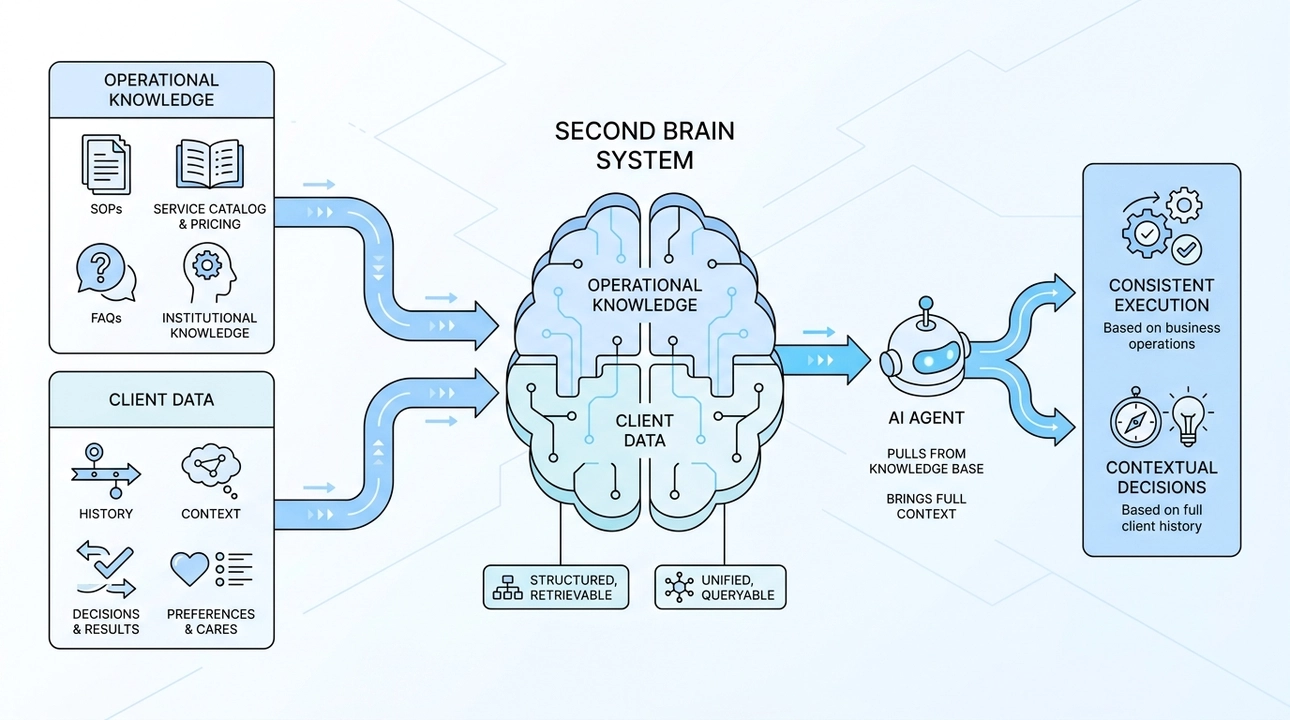
The first purpose is operational. Your second brain should house your SOPs, your service catalog, your pricing schedules, your FAQs, the institutional knowledge that lives in your head or in scattered documents across your team. Getting all of that into one structured, retrievable location is a prerequisite for working with AI effectively, because the AI needs to be able to pull from that knowledge base to make decisions and execute tasks in a way that is consistent with how your business actually operates.
The second purpose is as a unified customer database. This is the part that I think most agency owners underestimate. When an AI agent is working on a client campaign, it needs more than just the current state of that client. It needs the history. It needs the context that led to where things are today. What has been tried, what worked, what did not, what the client cares about, what decisions were made and why.
If that information is scattered across emails, Slack threads, random Google Docs, and individual team members' memories, the AI cannot retrieve it in any meaningful way. But if it is unified in a structured, queryable system tied to each client record, the AI can bring full context to every task it touches. That is the difference between an AI that feels useful and one that feels like it is constantly starting from zero.
Layer Three: Clean Up Your Processes Before You Hand Them Off
Once your structure and your knowledge base are in place, the next step is to look at your actual workflows. And here is where I want to be direct: do not try to automate a broken process. A bad workflow that a human executes imperfectly becomes a bad workflow that an AI executes at scale. That is not progress.
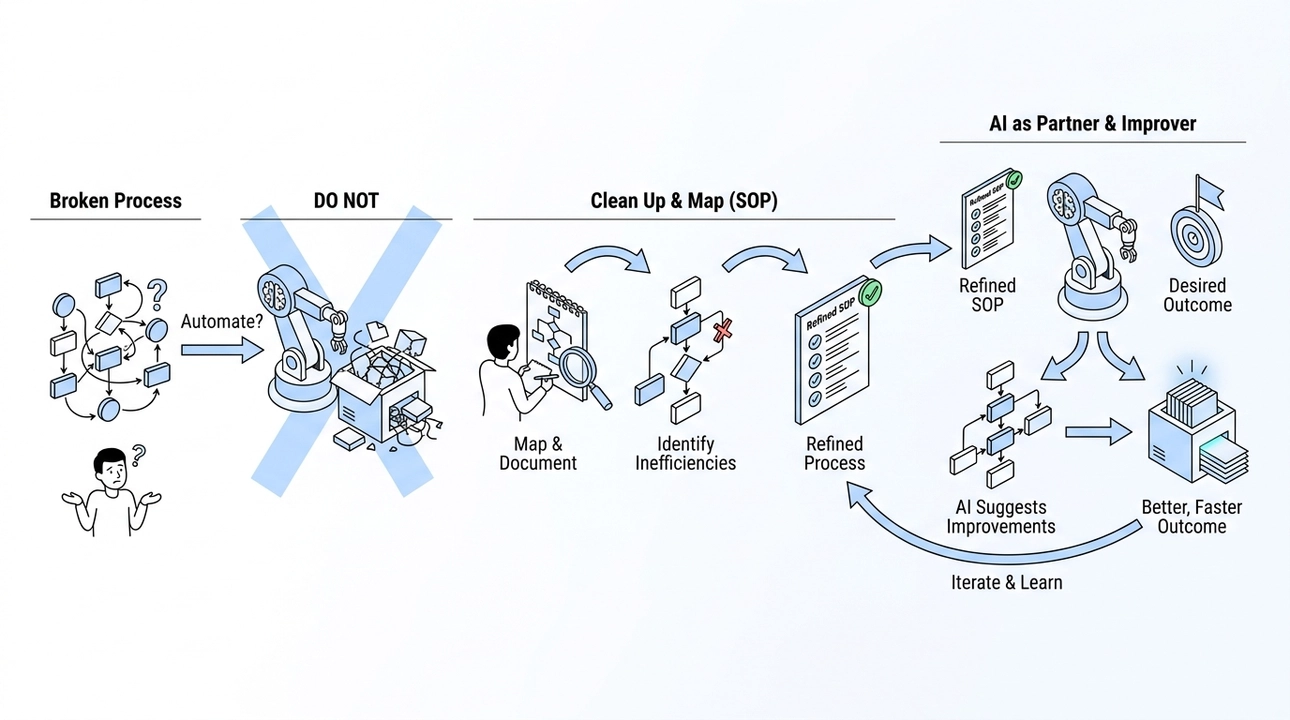
Before you assign any task to an AI agent, map it out in SOP format. Document how the work currently gets done, step by step. This exercise alone often surfaces inefficiencies you have been living with for years without realizing it. The act of writing a process down forces clarity that a vague mental model never demands.
But here is the part that surprised me when I first started doing this work, and it is the insight I find myself sharing most often now. When I started handing SOPs to AI models, I initially treated the process as sacred. Here is exactly how we do this, now automate it. What I found is that this is actually the wrong approach, or at least an incomplete one.
The models are capable enough now that if you give them the SOP and then also give them the desired outcome and the freedom to deviate from your documented process in the interest of efficiency, they will often improve on your SOP. They will find steps that can be combined, identify redundancies, or suggest a sequencing that gets to the same result faster. My workflows, as they exist today, are better than the SOPs I started with, because I trusted the model during the planning stage to treat the process as a starting point rather than a constraint.
This is a real mindset shift. Most people think of AI as an executor: give it a task, it does the task. What I have found is that it functions better as a process improvement partner, at least when you give it the room to play that role. The key is that your SOP needs to be producing a reliable, repeatable, desired outcome before you let the model iterate on it. You cannot hand it a broken process and ask it to make it better. You have to show up with something that already works, and then let the AI find ways to make it work even better.
The Real Cost of Skipping the Foundation
I want to come back to where I started, because I think it is worth being direct about this. The biggest mistake I see agency owners make is jumping into AI implementation before they understand their own operations. They see the demos, they see the potential, and they want to get there immediately. I get it. The capabilities are genuinely exciting.
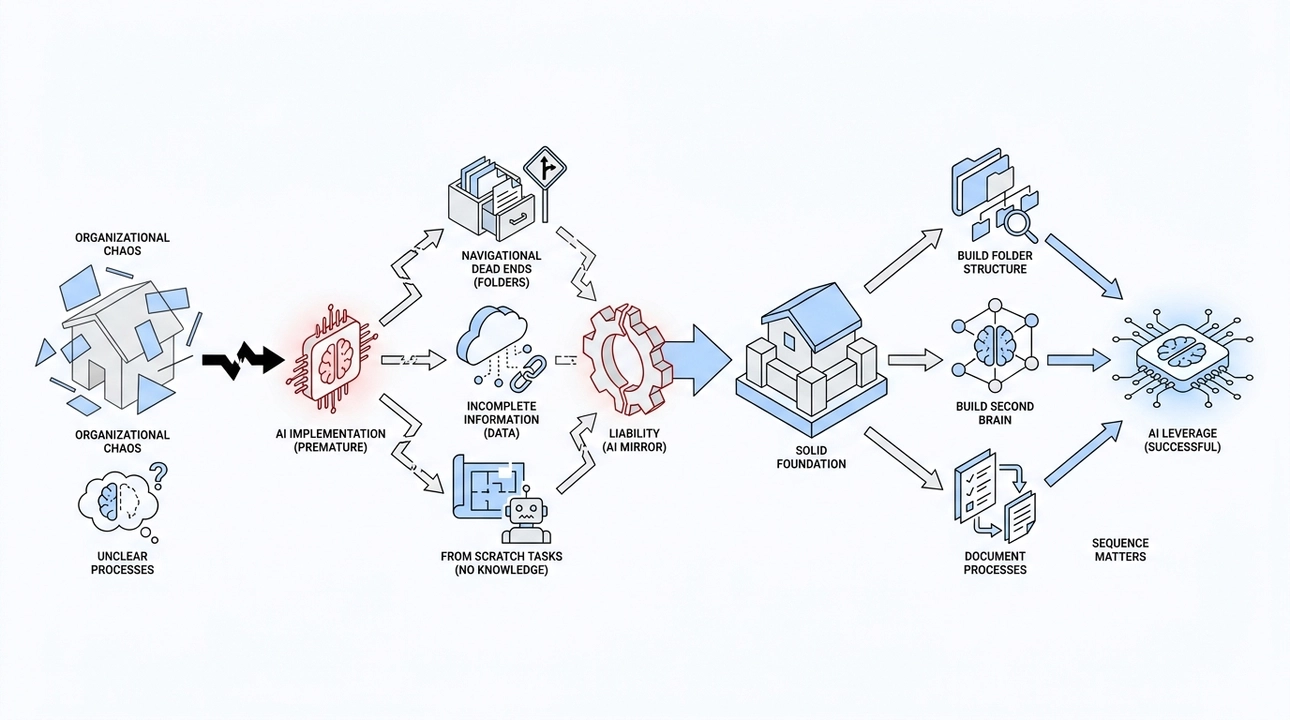
But what happens when you skip the foundation is that AI becomes a mirror for your disorganization. Unclear folder structures become navigational dead ends for your agents. Scattered client data means the AI is always working with incomplete information. Undocumented processes mean every task starts from scratch with no institutional knowledge to draw from.
The result is that AI stops feeling like leverage and starts feeling like a liability, and people conclude that it does not work for their agency. It does work. But it only works when it has something solid to build on.
Get your house in order first. Build the folder structure. Build the second brain. Document your processes. Then bring in the AI. That sequence matters more than any specific tool or model you choose, and it is the thing I wish someone had told me before I started.
Why Agency Owners Are Overpaying for Links That Google Has Learned to Ignore
There is a pattern that shows up on almost every agency sales call. A prospect comes in frustrated. Their client campaigns have gone stagnant. Rankings that used to climb are flat. Retainer renewals are getting harder to justify. And the instinct is usually to do more of the same: more guest posts, more niche edits, more links from sources with impressive-looking third-party metrics.
The problem is not effort. The problem is the model itself.
## The Old Playbook Is Getting Expensive and Less Effective
For years, link building in the local SEO world ran on a fairly predictable logic. Find a site with a decent DA or DR score, secure a placement, and expect some lift. Paid guest posts and link insertions became commoditized services because that logic seemed to hold. Agencies built their fulfillment stacks around it. Clients paid for it.
But Google has not been standing still. Its natural language algorithms have gotten significantly better at understanding topics, entities, and the relationships between them. That means Google is also getting better at identifying when a link comes from a source that has no meaningful topical or geographic relationship to the site it points to.
The result is that those traditional link sources are becoming less effective at the same time they are becoming more expensive. That is a compression on both sides. Agency margins shrink, retainer fees creep up, and clients grow frustrated when results do not materialize the way they used to.
Leaning on Moz or Ahrefs metrics to justify a link placement is not the same as understanding whether Google will actually assign value to it. Those tools measure what they measure. They do not tell you whether a link source is relevant to a tree service company in Charlotte or a plumber in Phoenix.
## Relevance Is Not a Theory, It Is Measurable
Here is where the conversation usually shifts for agency owners who are open to a different approach.
The question worth asking is not "does this site have good metrics?" It is "is this source topically or geographically relevant to the target?" And the follow-up question is equally important: can that relevance be determined with data before the link is ever built?
The answer is yes. Current tools and applications make it possible to analyze what types of links a site actually needs, based on the competitive landscape and the relevance signals that are already moving the needle in a given niche or geography. That is the difference between guessing and building with intention.
When this kind of analysis gets walked through with agency owners on a sales call, the response is consistent. It opens their eyes. Not because it is a complicated idea, but because it reframes the entire decision. Instead of asking "how many links can we get for this budget," the right question becomes "which specific types of links will actually be credited by Google for this particular client."
That shift in framing changes everything about how link building gets planned and executed.
## What a Data-Driven Approach Actually Looks Like
The core of a relevance-based link building strategy comes down to a few principles.
Source domains should be topically related to the niche of the target site, geographically relevant where applicable, or both. A link about tree care from a site that covers lawn and landscaping topics carries more weight than a link from a general lifestyle blog with a high DR score. That is not an opinion. That is how Google's understanding of topics and entities works in practice.
Beyond source relevance, the approach requires that each link source be selected with its intended target in mind. The model of recycling the same link sources across dozens of unrelated clients is exactly what Google's evolving algorithm is designed to devalue. Purpose-built relevance is the differentiator.
The agencies that are adapting to this shift are the ones showing clients real data during reporting, not just a list of placements. They can point to why each link was chosen, what relevance criteria it met, and how that connects to the competitive gap they are trying to close.
## The Stagnant Campaign Is Telling You Something
When a local SEO campaign stops moving, the temptation is to add more volume. More content, more links, more activity. But stagnation is usually a signal about quality and relevance, not quantity.
An agency owner who is willing to look at the data objectively will often find that their current link sources are expensive, loosely related to the client's niche, and increasingly ignored by the algorithm they are trying to influence. That is not a link building budget problem. That is a link building strategy problem.
The good news is that the correction does not require starting from scratch. It requires a better analytical framework for deciding which links are worth building in the first place. When that framework is applied, costs tend to go down because irrelevant placements stop eating up budget, and results tend to improve because the links that do get built are the ones Google is prepared to reward.
That is the core of what has changed. Google is better at understanding what is relevant. The agencies that build their fulfillment strategies around that reality are the ones that will hold onto clients and grow. The ones that keep buying overpriced placements on unrelated source domains are working against an algorithm that gets sharper every year.
The data is available. The tools exist. The only thing left is the willingness to use them.